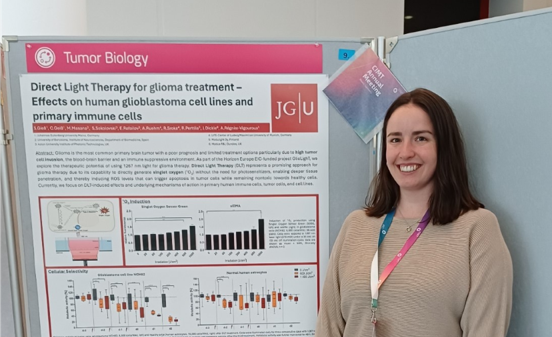
At the 23rd CIMT Annual Meeting (Europe’s premier meeting focused on cancer immunotherapy research) in May, Doctoral researcher Sophie Gieß from the GlioLighT UM team presented new work exploring the potential of Direct Light Therapy (DLT) for glioma treatment. Bringing together expertise from clinical research, photonics, and biomedical science across the consortium, this collaborative effort reflects a shared ambition: to open new avenues for treating one of the most challenging forms of brain cancer.
Revisiting Direct Light Therapy
DLT represents a novel direction in therapeutic innovation. By harnessing the unique properties of 1267nm light, the approach aims to directly generate reactive oxygen species (ROS) inside tissues. ROS can be thought of as a highly energetic forms of oxygen: they can damage important parts of a cell such as membranes, proteins, and DNA, leading to cell death. Cancer cells have naturally higher levels of ROS, so induced ROS production will overload cancer cells before healthy tissues.
Exploring Cellular and Immune Responses
The newly presented poster highlights the breadth of research currently underway within GlioLighT. Rather than focusing on a single biological system, the work spans tumour cells, supporting brain cells, and components of the immune system.
A central goal of this research is to better understand how DLT interacts with different cell types. Investigations are ongoing into how tumour cells respond to light-induced stress, as well as how healthy brain cells tolerate treatment conditions. At the same time, researchers are examining how immune cells, particularly macrophages, may be influenced by DLT, including potential changes in inflammatory behaviour and interactions with tumour cells.
Moving Towards More Realistic Models
Another important aspect of the work presented by the UM team is the use of increasingly sophisticated experimental systems. The team is studying three-dimensional tumour models and patient-derived materials that more closely mimic the structure and behaviour of gliomas in the human brain.
These models allow researchers to explore how tumour cells grow, interact, and invade surrounding tissues under different conditions. Understanding these dynamics is essential for evaluating whether emerging therapies like DLT can meaningfully impact disease progression. At the same time, the project is investigating how different treatment schedules and exposure strategies influence biological responses over time.
Mechanistic Understanding
A key scientific question driving this research is how DLT exerts its effects at the cellular level. Early investigations are examining pathways linked to oxidative stress, mitochondrial function, and long-term cellular responses such as cell cycle changes.
At this stage, these efforts are focused on building a robust mechanistic understanding that can support future development. As with all early-stage innovation, careful validation is essential; detailed results will be shared in forthcoming scientific publications, so keep an eye on our website and LinkedIn to stay up-to-date.
Looking forward
As our research continues, future updates will provide a deeper understanding of both the opportunities and challenges associated with this approach. For now, our outlook is cautiously optimistic: a growing body of work is bringing us closer to a new way of thinking about how light itself could be harnessed in the fight against brain cancer.

