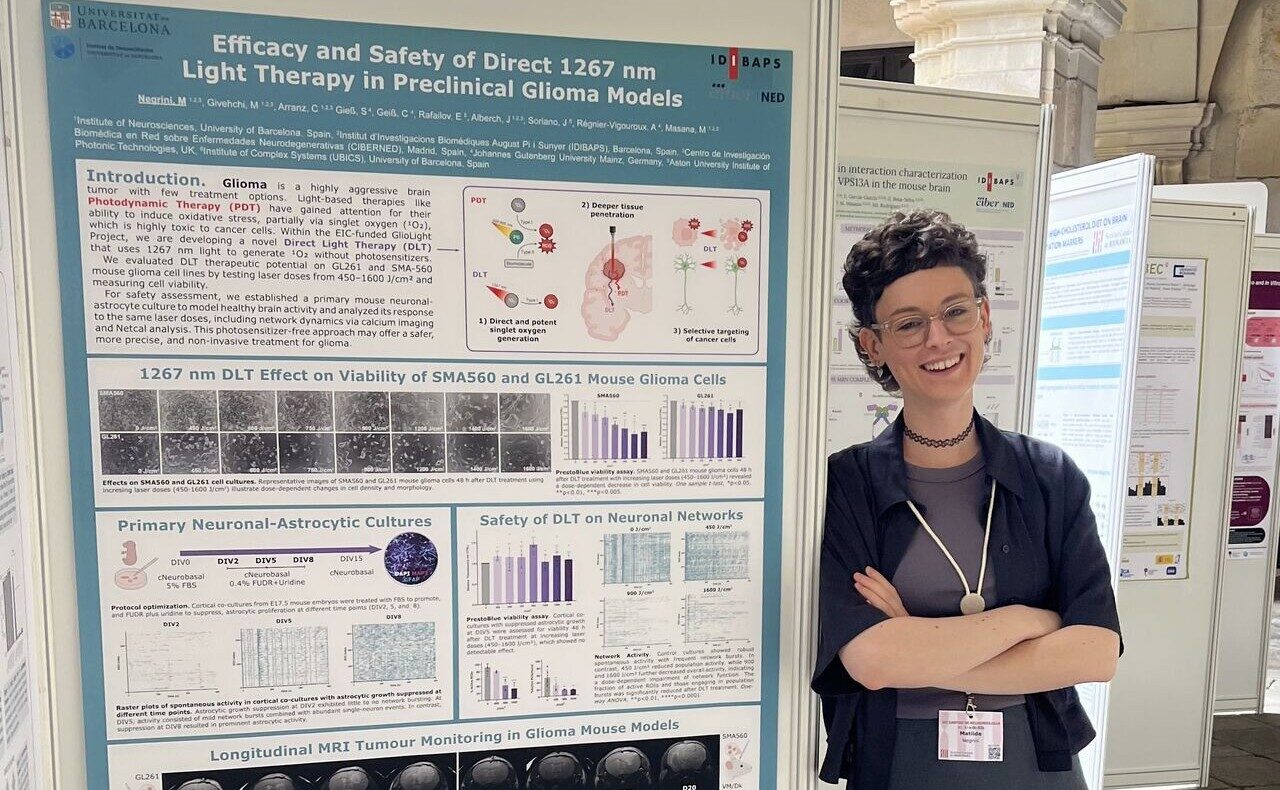
At the XIV Neurobiology Symposium of the Societat Catalana de Biologia, 3-4th June 2026, the GlioLighT UB team marked an important milestone with the presentation of their latest poster, highlighting ongoing work on GlioLighT’s novel approach to brain cancer treatment. The goal of our research is to demonstrate the therapeutic potential of DLT, building a promising platform for future medical applications.
Revisiting Direct Light Therapy
Direct Light Therapy (DLT) represents a novel direction in therapeutic innovation. By harnessing the unique properties of 1267nm light, the approach aims to directly generate reactive oxygen species (ROS) inside tissues. ROS can be thought of as a highly energetic forms of oxygen: they can damage important parts of a cell such as membranes, proteins, and DNA, leading to cell death. Cancer cells have naturally higher levels of ROS, so induced ROS production will overload cancer cells before healthy tissues.
Research findings
The research team at Barcelona is advancing the development of DLT within controlled laboratory environments. Using established biological models, our researchers are investigating how different types of tumour cells respond under varying conditions.
A central theme highlighted in the poster is the importance of maintaining the delicate balance between therapeutic impact and biological safety. In the context of brain health in particular, preserving the function of intricate cellular and neuronal networks is essential.
To address this, the research explores advanced laboratory models that replicate key features of healthy brain environments. These systems allow our researchers to examine how DLT may interact with both diseased and healthy tissues, helping to inform future optimisation strategies.
The poster also showcased our work towards extending research beyond simplified systems, incorporating additional techniques to better capture the complexity of disease progression. By bringing together simulated, in vitro, and in vivo results, the team is working towards a more comprehensive picture of how this emerging therapy might behave in human settings.
Looking Ahead
While the work remains at an exploratory stage, this milestone reflects a strong foundation for our ongoing progress. The full results from this poster will be presented in one of our upcoming publications, so keep an eye on our website and Linkedin to stay in the loop as we work towards a new safe and effective treatment for glioma.

